Home › Georgia › Georgia restaurant fire extinguisher rules and service tags
Georgia restaurant fire extinguisher rules and service tags
- Pick what you need and give your kitchen's ZIP code.
- Each service goes to the number of local companies you choose, from one to five. We check licenses where the law requires one and email you their names.
- You talk with them and decide. You hire and pay the company directly.
Facts checked 2026-11-15.
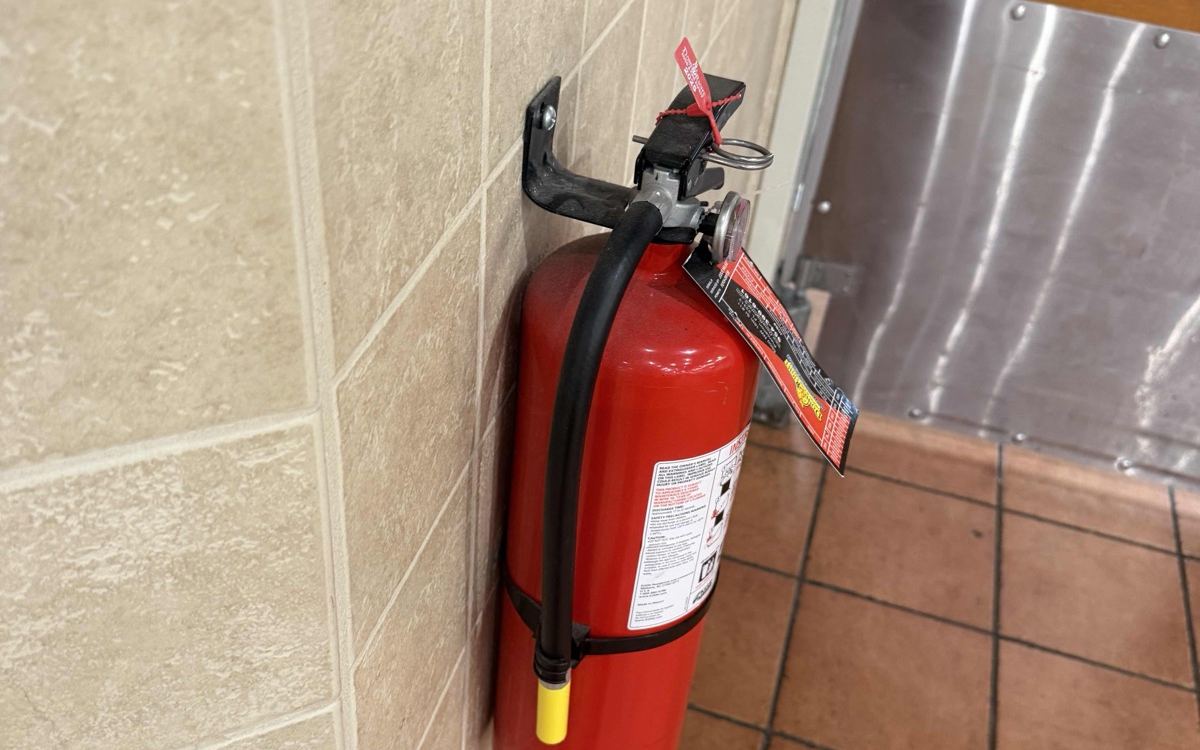
Portable extinguishers in a Georgia restaurant fall under state rules for who services them, what the tag says and how high the unit hangs. An owner or manager can verify most of it by looking at the tag and the wall bracket.
Which standard applies
The Safety Fire Commissioner's Rule 120-3-3 adopts the 2022 edition of NFPA 10, the portable extinguisher standard. Georgia used the 2018 edition before, and the switch took effect on May 27, 2025. Further changes to the rule have been proposed, so confirm which version is current.
The state layers its own conditions over NFPA 10:
- Anyone who maintains or recharges extinguishers needs a license or permit under Title 25, Chapter 12 of the Georgia code.
- Rule 120-3-23 governs the tags and the verification-of-service collars.
- A unit of 40 pounds or less hangs with its top at 48 inches or lower.
Class K near the hood
Kitchens with fryers or other grease-heavy cooking usually keep a Class K unit by the line. Georgia's fire code changes place that extinguisher, and the sign describing the operating sequence, 5 to 10 feet from the hood suppression system's manual release. A remodel that moves the hood moves the extinguisher with it.
A local company can take it from here. One form, free for restaurants.
Get connectedWho is allowed to service one
Rule 120-3-23 sets separate requirements for the company and for each technician.
The company holds a license from the Safety Fire Commissioner to install, inspect, repair, recharge, service or test portable extinguishers. It must be a current Georgia corporation carrying at least $1,000,000 in liability insurance. It also files sample tags and labels with the State Fire Marshal and shows a qualifying certification. The Commissioner can inspect a firm with or without notice.
Technicians hold their own permits and work for a licensed firm. A permit rests on a NAFED portable fire extinguisher technician certificate, another recognized certification or a manufacturer certification.
Under the same rule, any extinguisher required by law or code gets its installation, inspection, repair, recharge, service and testing from a licensed firm and a permitted technician only.
Reading the yellow tag
Georgia's extinguisher service tag is light yellow, 3 by 5.5 inches. Look for:
- the firm's name, address, phone and license number
- the technician's name and permit number
- the unit's serial number
- the service performed, the extinguisher type, and the month and year
- the agent weight and, where it applies, the hydrostatic test due date
- the words "DO NOT REMOVE"
Each service adds a fresh tag, and only the newest one stays on the unit. A tag that is missing, faded or out of date is a reason to call the firm that last serviced it.
The six-year maintenance label is a blue metallic decal that voids itself if removed. It carries the firm's license number and the technician's permit number.
When a unit does not pass
An extinguisher that is not maintained to NFPA 10 gets a non-compliance tag from the firm, which also sends its report to the authority having jurisdiction. That is typically the local fire marshal. The firm keeps its own inspection, test and maintenance records at its business address for at least two years.
You should hold a copy of each service report too, because the fire marshal may ask to see them.
A walk-through before the inspector
- Is each extinguisher seated on its bracket with pin and seal intact?
- Does every unit of 40 pounds or less sit at 48 inches or lower?
- Does each tag have a current date, the firm's license number and the technician's permit number?
- Is the Class K unit 5 to 10 feet from the hood system's manual release, beside the operating sign?
- Can staff reach every unit without moving stock?
Points two through four come from state rules. The local fire marshal's office can list anything else it checks.
Looking up a company
The Office of Insurance and Safety Fire Commissioner offers a public licensed professionals search. Find the firm, then match its license number to the one on a past tag, and ask for the technician's permit number too.
Independent licensed companies do this work, and you hire and pay them directly. Send the form with a Georgia ZIP and the extinguisher job, and it goes to one licensed local company.
Questions
What color is the service tag on a Georgia restaurant extinguisher?
It is light yellow and measures 3 by 5.5 inches. Kitchen suppression systems use a light blue tag in the same size.
What is the maximum mounting height for a Georgia restaurant extinguisher?
The top of a unit weighing 40 pounds or less must be no higher than 48 inches above the floor, a Georgia change to NFPA 10.
Where should a restaurant keep its Class K extinguisher?
Within 5 to 10 feet of the hood suppression system's manual release, together with the sign that explains the operating sequence.
Who is permitted to recharge a restaurant extinguisher in Georgia?
A firm licensed under Rule 120-3-23 using a permitted technician. The Safety Fire Commissioner issues both the license and the permit.
Sources
- Georgia Rule 120-3-3, State Minimum Fire Safety Standards (OCI PDF)
- Georgia Rule 120-3-3-.04, adopted standards and history
- Georgia Rule 120-3-23-.04, extinguisher firm licenses
- Georgia Rule 120-3-23-.05, extinguisher technician permits
- Georgia Rule 120-3-23-.13, service and records
- Georgia Rule 120-3-23-.14, tags
- OCI fire suppression professionals licensing
- OCI licensed professionals search