Home › Texas › Restaurant hood fire suppression in Texas
Restaurant hood fire suppression in Texas: rules and tags
- Pick what you need and give your kitchen's ZIP code.
- Each service goes to the number of local companies you choose, from one to five. We check licenses where the law requires one and email you their names.
- You talk with them and decide. You hire and pay the company directly.
Facts checked 2026-11-15.
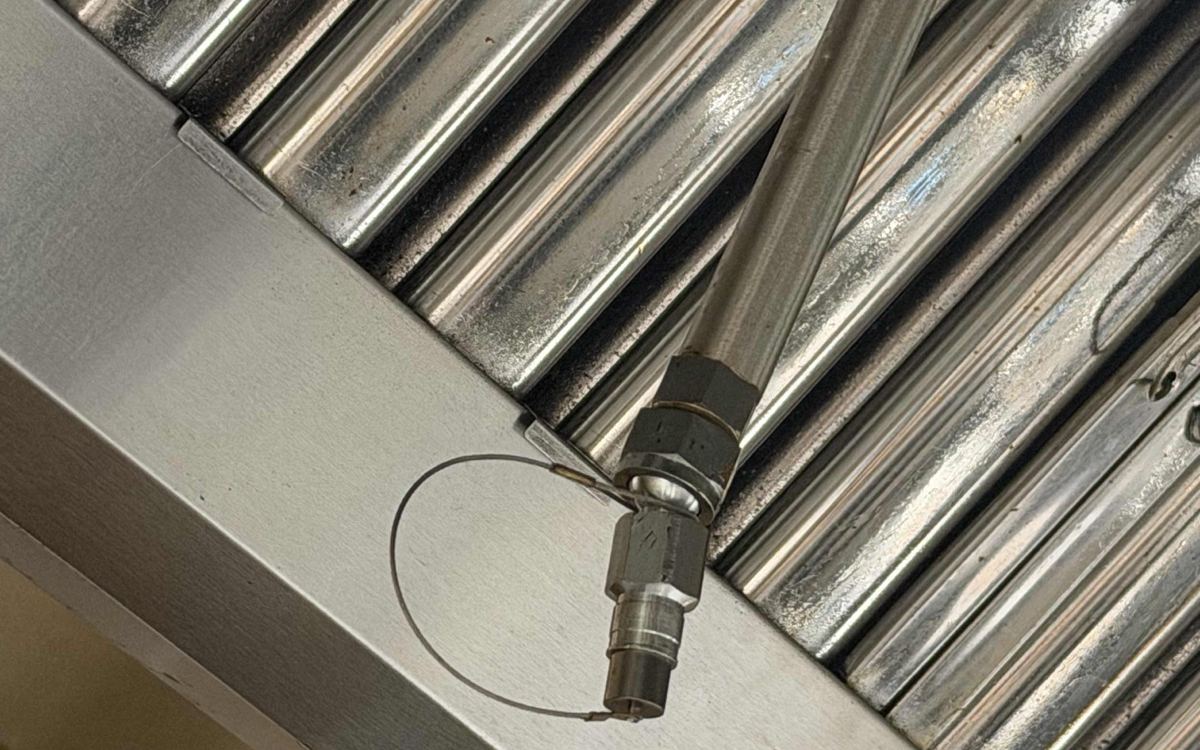
Installing or servicing the fire suppression system over a restaurant hood is work for a company registered with the Texas State Fire Marshal's Office and technicians that office has licensed. The interval between checks comes from your local fire marshal. In Houston, a system is inspected and given a new tag at least every 6 months.
What the system is
A pre-engineered system arrives as a factory-designed kit, fusible links included, that covers the cooking line and the hood. Texas fire rules say commercial cooking systems of this kind must pass the UL 300 test standard. Anything installed or altered after July 1, 1996 needed to meet it, and older systems had until January 1, 2008 or faced a red tag.
Who may service it in Texas
The State Fire Marshal's Office (SFMO) sits inside the Texas Department of Insurance (TDI). Its job is to license individuals and register companies.
| Who | What they may do |
|---|---|
| Company holding a Fire Extinguisher Certificate of Registration | Install and service extinguishers and fixed systems as a business |
| Type K licensee (Kitchen Cooking Systems) | Install, certify or service pre-engineered systems over a cooking area, plus portable extinguishers |
| Type A licensee (Fixed Systems) | Install, certify and service every pre-engineered fixed system and portables |
| Apprentice permit holder | Work only under a licensee's direct supervision, with the licensee signing every document |
Licenses depend on a registered employer, and a registration depends on a licensed employee. On the job, technicians carry proof of their license. TDI's company and licensee search lets you look up a company or a person.
A custom design that is not pre-engineered has to be planned by a Type PL licensee or a professional engineer.
A local company can take it from here. One form, free for restaurants.
Get connectedService tags and red tags
Each service ends with a tag marked "Do not remove by order of the State Fire Marshal." It lists the company and its registration number. It also shows the technician's name, license number and signature, the month and year, the work performed and the owner's name. Removal is limited to an authorized employee of a registered company, the SFMO or a regulating agency.
A system that is unsafe or will not work triggers a different procedure. The company tells you in writing, informs the local fire authority within 24 hours and hangs a red tag marked "DO NOT REMOVE--EQUIPMENT IMPAIRED." A written copy reaches the authority within three business days. The ordinary service tag returns only once the faults are repaired and the system has been tested again.
When a fusible link is replaced, state rules call for the maker's date stamp on it. The service tag records the link's year of manufacture, its temperature rating and how many were fitted.
How often it is checked
State rules adopt NFPA 17A, the national standard for wet chemical systems, but the schedule you answer to is your local fire marshal's. Houston Fire Department's standard has an approved fire protection equipment company inspect and tag hood suppression systems at least every 6 months, and again after any discharge. Gainesville's fire safety inspection page describes a third-party inspection of kitchen suppression systems every 6 months.
Your fire marshal's office can tell you what it enforces and what paperwork it wants to see.
Installation, labels and permits
At the final test of a new system, the licensee who certifies it has to be there. A label goes on the control head or panel, you receive an installation certificate and the local fire authority gets a copy if it asks for one.
Cities add requirements of their own. Midlothian wants fuel gas and electricity to the cooking equipment cut when the system trips, the exhaust fan left running and a link to the building fire alarm where one exists. Dallas puts a fire permit for commercial cooking fire-extinguishing systems in its fee schedule. Houston's amended fire code calls for a system listed for commercial cooking and installed to that listing, NFPA 96 and the maker's instructions.
What to ask a company before you hire
- Is the company registered with the SFMO, and does the technician hold a Type K or Type A license?
- Does the technician attach the state tag and describe the work done?
- Is a city permit needed, and who files it?
- If something fails, will the red tag notice come to you in writing?
A suppression install, change or inspection request from a Texas kitchen goes to one licensed local company through the form.
Questions
How often is a Texas restaurant's suppression system serviced?
That depends on the city. Houston calls for inspection and a tag at least every 6 months and after any discharge, and Gainesville describes a third-party check on the same cycle. Your local fire marshal can say what applies to your address.
Must a suppression technician be licensed in Texas?
Yes. State law lets only licensed technicians, or apprentices under their supervision, install or service these systems, and the employer needs a state registration. Type K and Type A licenses cover kitchen work.
What does a red tag on a suppression system mean?
The system is unsafe or will not work. The company has to notify the owner in writing and tell the local fire authority within 24 hours, and the tag stays until repairs are made and the system is rechecked.
Does a commercial kitchen system have to meet UL 300?
Pre-engineered commercial cooking systems do. Texas required it for systems installed or changed after July 1, 1996, and for older ones by January 1, 2008.
Sources
- TDI, fire extinguisher registration, license and test information
- TDI, fire industry licensing
- 28 TAC 34.511, license types
- 28 TAC 34.512, apprentice permits
- 28 TAC 34.517, fixed system requirements
- 28 TAC 34.519, installation labels and certificates
- 28 TAC 34.520, service tags
- 28 TAC 34.521, red tags
- 28 TAC 34.507, adopted standards
- Houston Fire Department LSB Standard 02
- Houston amendments to the 2021 International Fire Code
- Gainesville fire safety inspection
- Midlothian Fire Marshal's Office, fire protection inspections
- Dallas Fire-Rescue schedule of permit fees