Home › Florida › Kitchen hood fire suppression systems
Kitchen hood fire suppression systems: Florida rules
- Pick what you need and give your kitchen's ZIP code.
- Each service goes to the number of local companies you choose, from one to five. We check licenses where the law requires one and email you their names.
- You talk with them and decide. You hire and pay the company directly.
Facts checked 2026-11-15.
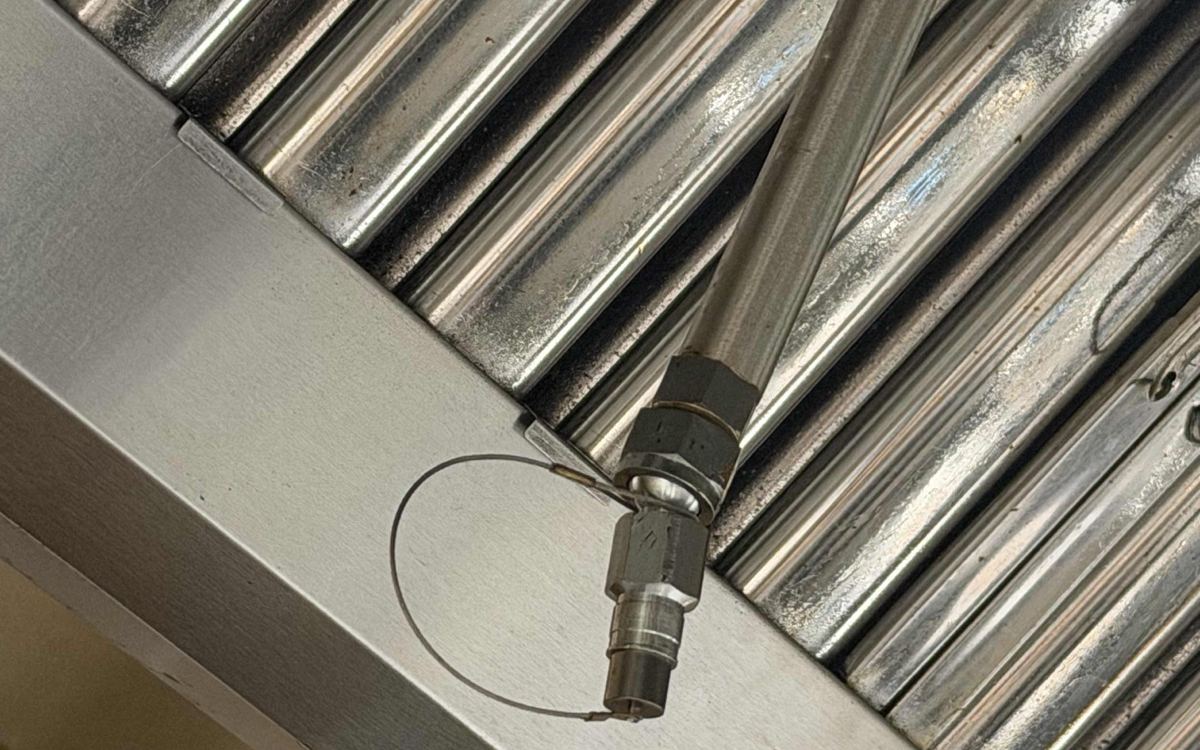
Over a restaurant cooking line sits a set of fixed nozzles that discharge wet chemical when a fire starts. Florida allows only a company licensed by the State Fire Marshal to put one in or service it, and the local fire marshal looks at the tag. Service twice a year is the common expectation. Commercial Kitchen 101 passes requests to local companies and does not do the work.
What the code asks for
An approved automatic suppression system is required by the Florida Building Code wherever an appliance calls for a Type I hood. Fryers, griddles, ranges and charbroilers that give off grease or smoke fall in that group. The hoods and exhaust guide covers the hood itself.
Most kitchens have a pre-engineered system. Florida law describes it as one listed by a nationally recognized testing laboratory and installed within the limits the maker tested it to, following the NFPA standards.
The Florida Building Code, Building, adds these details:
- Testing to UL 300, the fire test standard for kitchen suppression systems, with the system listed and labeled.
- A manual pull station at or near an exit from the cooking area, 10 to 20 feet from the exhaust system and 42 to 48 inches above the floor, needing no more than 40 pounds of force.
- Automatic shutoff of fuel or electric power to the cooking equipment when the system discharges, with a manual reset.
Florida adopts NFPA 17A (2021) for pre-engineered wet chemical systems and NFPA 17 (2021) for dry chemical ones. The local fire marshal enforces whichever edition applies in that jurisdiction.
A new installation
An installation comes with a drawing. The licensed company's first report names the system type, maker, model and bottle size. The local fire marshal can say what it wants on hand before final approval.
Because the design is matched to the appliances beneath the hood, changes matter. Adding a fryer, trading a griddle for a charbroiler or shifting the line are all reasons to have the licensed company review the layout first, and only a licensed company may carry out that work.
A local company can take it from here. One form, free for restaurants.
Get connectedTwice-yearly service
Service every six months is the usual expectation. A county fire checklist in Florida asks for a service tag dated within the last six months, and the state's dealer rules list "semi-annual" among the report types filed for a pre-engineered system.
Florida Administrative Code Rule 69A-21 sets these requirements:
- A standard service tag on each serviced system, showing the company name and the technician's permit number.
- A report for every installation, inspection and service. It lists the system type, maker, model, bottle size, last hydrostatic test and recharge dates, and whether the fuel shutoff works. A new installation adds a drawing.
- One signed copy for the owner and one kept by the dealer for at least three years.
An inspector or insurer may ask to see those copies, so they belong in a folder at the restaurant.
Health departments in other states, working from older NFPA editions, say trained staff can check the system monthly. The fire marshal can say whether Florida's edition expects the same.
Who is allowed to work on it
Section 633.304 of the Florida Statutes requires a State Fire Marshal license to service, repair, recharge, test, inspect or install fire extinguishers and pre-engineered systems. The classes are:
| Class | Covers |
|---|---|
| Class A | All fire extinguishers, including hydrostatic testing of all types |
| Class B | Extinguishers, hydrostatic testing excluding CO2 |
| Class C | Extinguishers, excluding CO2 recharge and CO2 hydrostatic testing |
| Class D | Pre-engineered systems, which includes restaurant hood systems |
The license is held per business location, and each person doing the work holds a permit. That technician carries the permit and a photo ID and shows both on request. A trainee may work only with a permit holder physically present, and a trainer supervises no more than two trainees.
Licenses and permits expire on December 31 of odd-numbered years. Renewal takes 16 hours of continuing education.
Checking a company
- Ask for the Class D license number, or an A, B or C number if extinguishers are serviced too, along with the technician's permit number.
- Confirm the numbers with the State Fire Marshal's licensing office, which lists (850) 413-3171 and [email protected].
- Read the tag left on the system. It should show the company name and the permit number.
- Request the report after every visit.
- Look at how the company advertises. Contracting or advertising it without a license is a crime in Florida, and falsely claiming ability beyond a license is unlawful.
Fire chiefs, fire inspectors, fire marshals and insurance inspectors sit outside the licensing section, so their staff need no Class D license to inspect.
When the form arrives with your kitchen's ZIP code and a suppression service or new installation, one licensed local company receives the request.
Questions
How frequently should a restaurant suppression system be serviced?
Twice a year is typical. One Florida county checklist asks for a tag from the last six months, though the local fire marshal's office makes the final call.
Which license covers installing a restaurant hood system in Florida?
A Class D license from the State Fire Marshal covers pre-engineered systems, and each technician also needs a permit. Every business location holds its own license.
What does UL 300 mean for a kitchen suppression system?
It is the fire test standard for kitchen suppression systems. The Florida Building Code wants restaurant hood systems tested to it, then listed and labeled.
Should I call someone before moving cooking equipment under the hood?
Yes, call the licensed company first. The system is installed within tested limits, and its nozzles are matched to the appliances now under the hood.
Sources
- Florida Statutes 633.304, fire equipment licenses
- Florida Statutes 633.102, definitions
- Chapter 69A-21, Florida Administrative Code (State Fire Marshal PDF)
- Rule 69A-3.012, adopted NFPA editions
- Florida Building Code, Building, chapter 9 (UpCodes copy)
- State Fire Marshal, regulatory licensing
- Florida Statutes 489.127, unlicensed contracting
- Charlotte County Fire/EMS pre-inspection checklist
- Minnesota Department of Health, protection of kitchen cooking equipment